PROVEN - Excellent - Texas
Little Elm TX Roofing: Hail, Lake Wind and a Town of First-Generation Roofs
A lakeside Denton County town that went from 3,646 people in 2000 to 46,453 in 2020 — which means most of Little Elm is still wearing its original builder roof, and a great deal of it is aging out at the same time. R&S is family-owned and GAF Certified, and we cover the town from McKinney. Getting up there to look costs you nothing.
Little Elm wraps the north and east shores of Lewisville Lake in Denton County, and the town calls itself the Town with a Lake Attitude. It is also one of the fastest-growing municipalities in Texas by percentage, and its growth curve explains nearly everything about the roofs here: 3,646 residents in 2000, 25,898 in 2010, 46,453 at the 2020 census, roughly 55,000 today, with build-out anticipated somewhere near 90,000. A town does not accumulate that kind of housing gradually. It gets laid down in subdivisions, several hundred roofs at a time, by the same crews using the same product in the same season.
The census record says the same thing in shingle terms. The median Little Elm home was built in 2011. Roughly 36 percent of the housing stock went up between 2000 and 2009, another 42 percent between 2010 and 2019, and well under one percent of it predates 1950. Call it 19,800 housing units, a median value in the low four hundreds, overwhelmingly detached single-family houses in master-planned subdivisions, and overwhelmingly finished in builder-grade architectural asphalt shingle.
A Whole Town Reaching Roof Age at Once
Here is the part that catches Little Elm homeowners out. The 2000s wave of houses is now sixteen to twenty-five years old, which is at or past the practical service life of the standard architectural shingle a production builder puts on a subdivision. The 2010s wave — the larger of the two — is into the second half of its own life. This is, to an unusual degree, a first-generation-roof town: most of it is still on the roof the builder nailed down, or on its first replacement, and a very large share of it is arriving in replacement range simultaneously.
Two things follow. “Three houses on my street just got new roofs” is not neighbourhood gossip here, it is a data point about your own house, because those roofs went on the same month as yours. And age compounds storm damage: a twenty-year-old shingle that has already shed part of its granule cover does not need a record-breaking stone to fail, only an ordinary one.
What the Weather Actually Does Up Here
The National Weather Service office in Fort Worth is flat about the regional risk: large hail, damaging winds, flooding and tornadoes all occur in the Dallas–Fort Worth metroplex nearly every year, although any one location is unlikely to see all of them in the same year. The same office notes that thunderstorm frequency and severe weather peak in spring. On the ground that reads as March through June, with April and May doing most of the damage, and a smaller second severe-weather peak in the fall around October.
For scale on the hail specifically: the National Insurance Crime Bureau’s analysis of hail loss claims filed between 2017 and 2019 put Texas first among all states with 637,977 claims, well clear of second-place Colorado at 380,066. In that same analysis McKinney ranked fourth among all U.S. cities with 34,134 claims, and Dallas fifth with 25,262. McKinney is the town our Dallas–Fort Worth crews work out of, twenty-odd miles east of Little Elm. This is not somebody else’s weather we are describing.
Hail. The damage that matters is usually the damage you cannot see from the driveway. A stone bruises the asphalt mat beneath the surface, knocks granules loose, and cracks or fractures shingles that still lie flat and look perfectly tidy from the ground. Soft metal confesses faster — dented gutters, vent caps, flashing and ridge caps are often the first honest evidence on the property. And granule loss does not produce a leak on day one. It removes years from the roof quietly, long before anything shows up on a ceiling.
Wind. Straight-line thunderstorm winds lift, crease and strip shingles, and they concentrate along the edges — ridges, rakes and hips. Little Elm gives wind a cleaner run at a roof than most suburbs manage: lots face open water across the lake on one side and open prairie on the other, with little upwind tree cover to break the fetch. A creased shingle that flops back down looks untouched and is no longer sealed to the course below it. The next rain that arrives at an angle finds the gap.
Heat. Summer temperatures here run consistently in the 90s and often reach or exceed 100 degrees, thermally cycling an asphalt roof every day of the season, drying the sealant strips that bond one course to the next and leaving the shingle more brittle. A roof that has been baked all summer meets the following spring’s hail in worse shape than its age suggests.
When a First-Generation Little Elm Roof Is Worth Repairing
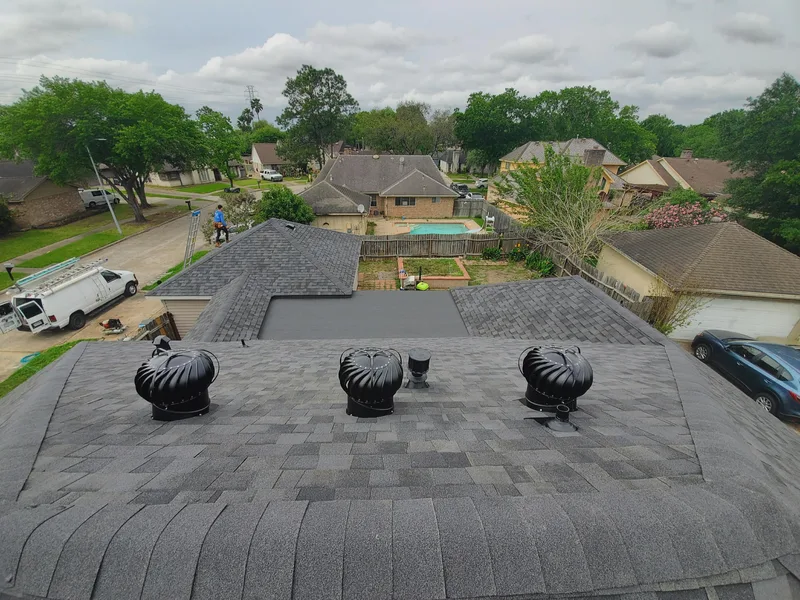
Little Elm splits fairly cleanly into two answers, and the line runs somewhere around 2010. On the newer half of town, a lifted rake, a creased ridge cap and a split pipe boot is a roof repair and nothing more, and a contractor who turns that into a tear-off is selling rather than diagnosing. On the 2000s half the arithmetic changes: bonding a patch to a shingle that has already given up its granules and its seal buys you a season and quietly costs you the replacement you may have been owed. The third answer — leave it alone — is one we give more often than homeowners expect, and hearing it costs nothing either way. What moves a roof from one column to the other is the state of the asphalt mat and how many slopes are involved, and neither of those is readable from a photograph taken in the driveway. That is what the inspection is for.
We climb it, photograph every slope, stop the water where it is getting in, and put the findings in writing. The look itself is free, anywhere between the lake and US 380.
Where a Twenty-Year-Old Roof Meets an Adjuster
The argument in a town of first-generation roofs is almost never whether hail fell. It is whether a twenty-year-old shingle failed because of the hail or because it was twenty years old, and drawing that line is exactly what an adjuster is paid to do. R&S was started by somebody who worked inside the insurance industry before roofing, so a Little Elm roof gets documented the way a file needs documenting: photographs slope by slope, the soft-metal evidence, and a plain note of what is storm damage and what is simply wear. That is what our roofing insurance coverage work amounts to — we build the record, your carrier decides the claim, and if the record says there is nothing to file you will hear that first.
One thing is peculiar to streets that were all roofed in the same month. After a serious spring storm, out-of-town crews work these subdivisions door to door precisely because a single hail core lands on hundreds of roofs of identical age. Ask whoever knocks where their office is and how you reach them next February. Ours is 108 Belden Circle in McKinney, and it will still be answering. Our hail damage assessment and wind damage assessment pages set out what we actually look for.
Twenty-Odd Miles East on US 380
Plainly: R&S has no office in Little Elm, and we are not going to pretend we do. We cover the town from our Dallas–Fort Worth office at 108 Belden Circle in McKinney — about seventeen miles as the crow flies, twenty to twenty-five by road, essentially a straight run west along US 380. Little Elm sits in Denton County and McKinney in Collin, but both are on the same northern arc of the metroplex, and the drive is the boring kind.
Once we are in town the orientation is simple enough. FM 423 is the north–south artery everybody navigates by; US 380, signed University Drive, runs across the top of town; FM 720 and Eldorado Parkway carry the middle, past Town Hall at 100 W. Eldorado. If you want landmarks rather than road numbers: Lewisville Lake itself, the wooded acres and disc golf at Beard Park, the fishing dock at McCord Park, Cottonwood Park and Cottonwood Creek Marina, Little Elm Park and The Lakefront district downtown, and the Little Elm ISD athletic complex. Four school districts serve parts of this town — Little Elm ISD plus Frisco, Denton and Aubrey ISD — which tells you how fast it grew and in how many directions.
Little Elm Neighborhoods We Work In
These are neighbourhoods registered with the Town of Little Elm, listed across its eight zones:
- Sunset Pointe
- Sunset Place
- Union Park
- Paloma Creek
- Valencia on the Lake
- Frisco Ranch
- Frisco Hills
- Lakewood Estates
- Wynfield Farms
- Prairie Oaks
- Eldorado Estates
- Eldorado Estates West
- Bay Ridge Estates
- Sunrise Bay
- Shell Beach
- Ladera
- The Enclave at Oak Grove
- Stardust Ranch
- Robinson Ridge
- Villages of Woodlake
- Glen Cove
- Kings Crossing
- Kings Court
- Marina Vista Estates
- Brentwood
- Calloway Trails
- Northlake Estates
- Linden Hills
- Hillstone Pointe
- The Reserve at Spiritas Ranch
- Lakeside Cove
Registering with the Town is voluntary, so that is a list of real Little Elm neighbourhoods rather than all of them. If your subdivision is not up there, phone us with the name — we still cover it.
What Is Your Little Elm Roof Doing?
Describe the symptom — a brown ring on a ceiling, granules collecting in the downspout, shingles that looked wrong after the last storm, or simply a house you bought in 2007 whose roof has never been touched — and somebody from R&S will drive out, climb up and report what is actually on the deck. Our Google rating stands at 5.0 across 294 reviews, and the reviews say it better than we can.
We work Little Elm as part of the Dallas–Fort Worth side of the business, alongside Frisco immediately east, Denton across the county, and Prosper up on the other side of US 380.
Questions Little Elm Homeowners Ask Us
Is there an R&S office in Little Elm?
No. There is no R&S office in Little Elm and we are not going to dress one up for a web page. The nearest is our Dallas–Fort Worth office at 108 Belden Circle, McKinney, TX 75069 — twenty to twenty-five miles east, essentially one road the whole way, US 380. Little Elm has been inside that office’s territory the entire time. Call (832) 743-8434 and somebody will drive out and get on the roof.
Does being out near the lake change what happens to my roof?
It changes the wind half of it. Little Elm gives a storm a cleaner run at a roof than most suburbs manage: open water across Lewisville Lake on one side, open ground on the other, and not much upwind tree cover to slow anything down. Wind works the edges first — ridges, rakes and hips — where it lifts a shingle, creases it, and drops it back looking untouched. The crease has broken the seal to the course underneath, and the next rain arriving at an angle finds the gap. If your lot faces open water or open field, the edges are where we start.
When is hail season in North Texas?
The National Weather Service notes that thunderstorm and severe weather frequency in the Dallas–Fort Worth area peaks in spring. In practice that means roughly March through June, with April and May doing most of the damage, plus a smaller second severe-weather peak in the fall around October. The National Insurance Crime Bureau’s analysis of 2017 to 2019 hail claims put Texas first among all states, and ranked McKinney fourth among all U.S. cities.
Three houses on my street got new roofs this year. Should I read anything into that?
More than you would on an older street, yes. Subdivisions here went down in batches, so the roofs on your block were nailed on within a season of one another, by the same crews, out of the same pallet of builder-grade architectural shingle. If three of them have reached the end, yours is the same age and has taken the same storms off the same direction. That is not a verdict on your roof — it is a reason to have somebody read the mat and the granule cover instead of the calendar. Plenty of those roofs still have years in them, and we say so when they do.
Real Google reviews
Three customers on insurance, a tornado and a one-day roof
Three of the 294 Google reviews behind our 5.0 rating, reproduced exactly as the customers typed them, spelling and all.
Incredible experience! I had been turned down by my insurance to cover new roof. R&S guided me through the process to appeal and request new assessment. At the end, I won and my roof was replaced and covered … including solar panel removal and re-placement. Joseph managed a great crew. Also, ROOF WAS REPLACED IN ONE DAY!!!
This people did a amazing job in my roof, 100% recommend
Insurance denied me couple times and they finally got it !
I would recommend 100% R& S roofing. This roofing company made my life so much easier the process of replacing my roof after the tornado we had back in May. Logan the project manager came to my rescue in a couple of hours and explained to me the whole process as I never had any problem before nor I knew what to do. The job was completed in one day and the crew cleaned up the area really well. The job was completed with no issues or surprises.
Nearby
Roofers near Little Elm
All of these sit on the same northern arc of the metroplex our McKinney office covers, and a spring hail core does not stop at a town line.
Little Elm, TX
Book a free roof inspection in Little Elm
Whatever it is doing — dents in the gutters after an April storm, granules in the downspout, a shingle that lifted and never sat back down, or a roof that was already old when you bought the house — describe it and we will come and see for ourselves.
(832) 743-8434108 Belden Circle · McKinney, TX 75069